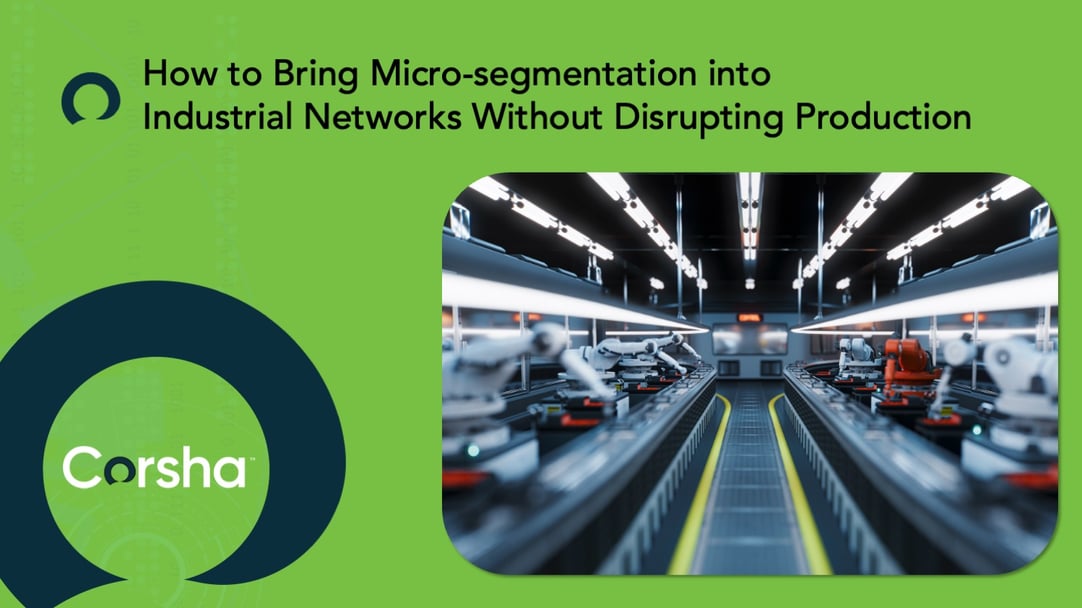
A practical guide for securing identity and access control to reduce lateral risk in complex industrial environments.
In industrial manufacturing, food and beverage processing, and other high-throughput environments, plant networks are often flat, aging, and highly interconnected. Every new connection from a new system controller to a technician or vendor configuring a PLC can unintentionally expose other systems and zones on the network to malicious attacks or unexpected downtime.
As modernization accelerates, more machines are connected, more vendors gain access, and more sessions traverse the same open network paths. In this environment, microsegmentation is a critical necessity. But the traditional approach of rearchitecting networks, reconfiguring firewalls, or rebuilding VLANs simply isn’t feasible when many legacy systems were built for uptime, not security.
So let’s dig into how we can achieve the benefits of microsegmentation without risking the network and without impacting production performance?
The Challenge with Segmentation in Industrial Environments
Many industrial networks were never designed for segmentation. They were built for uptime, simplicity, and accessibility.
That design creates challenges:
- Flat networks where internal trust is assumed
- Overlapping access between users, devices, and zones
- Shared VPNs or jump boxes offering unrestricted reach
- Limited or no visibility into lateral movement across control systems
These conditions leave security and operational teams without the infrastructure, visibility or control to prevent unwanted access between zones or systems. And changing the underlying network in one fell swoop can be risky or out of scope for many production environments.
A Real-World Problem: One Connection, Many Risks
Imagine a production system vendor accessing a facility for scheduled maintenance. They connect through a shared VPN, reach the target PLC and several others. Because the network has no enforced segmentation, that single session now exposes all production lines, control servers, and even downstream systems to both security risk and potential downtime.
Even if the technician behaves responsibly, credentials may linger. No one sees what else was accessed. The vendor could repeat the same process next week using the same login. Or worse, an attacker could phish the technician and steal the stored credentials and try to use them.
Unfortunately, this has become a common pattern across industrial operations.
What Microsegmentation Should Look Like in Industrial Networks
A modern approach to segmentation in industrial environments doesn’t actually start with the network; rather it all starts with identity and access control. When you can control what and who are connecting, where they’re connecting from, and what they’re allowed to reach, you can enforce segmentation at the session level, dynamically.
Here’s what that looks like in :
- Each machine and user is provisioned and verified with a unique, dynamic identity
- Connections are restricted to specific systems, functions, or zones
- Access is granted just in time, and revoked automatically when complete
- No unnecessary lateral movement is possible
- All connection and session activity is visible in real time
With this model, access is constrained by intent, not static identifiers or network location. As a result, segmentation becomes an outcome of how connections are managed, and not how the network was designed at some point long ago.
How Corsha Helps You Segment Without Disrupting Production
Corsha enables a non-disruptive, identity-first approach to microsegmentation tailored for industrial environments.
- Dynamic machine identities verify users and devices before granting access
- Session-based segmentation enforces policies without touching VLANs or firewalls
- Real-time policy enforcement controls who can access what, when, and for how long
- Automated access expiration eliminates cleanup and reduces human configuration error
- Native integration with OT and ICS systems and protocols, remote access platforms, and industrial workflows because teams don't have time or budget for rip-and-replace
Corsha brings identity-based micro-segmentation into existing operations without adding friction or risk. It makes access smarter, connections safer, and lateral movement virtually impossible without overhauling the underlying architecture and infrastructure. Simply put, Corsha is the faster, easier, more efficient way to secure your OT connections.
Segment Smarter Without Slowing Down
Microsegmentation doesn’t have to mean months of planning, forklift upgrades, or painful plant disruptions. By incrementally tying access to identity across the plant and controlling connections in real time, you can achieve the outcomes of microsegmentation without the traditional overhead. It also makes it easy to bridge modern and legacy systems without reengineering your environment and without downtime.
Corsha helps you bring microsegmentation into your operations invisibly, securely, and at scale.
Book a demo and see how to bring identity-based microsegmentation into your industrial networks without disrupting production.